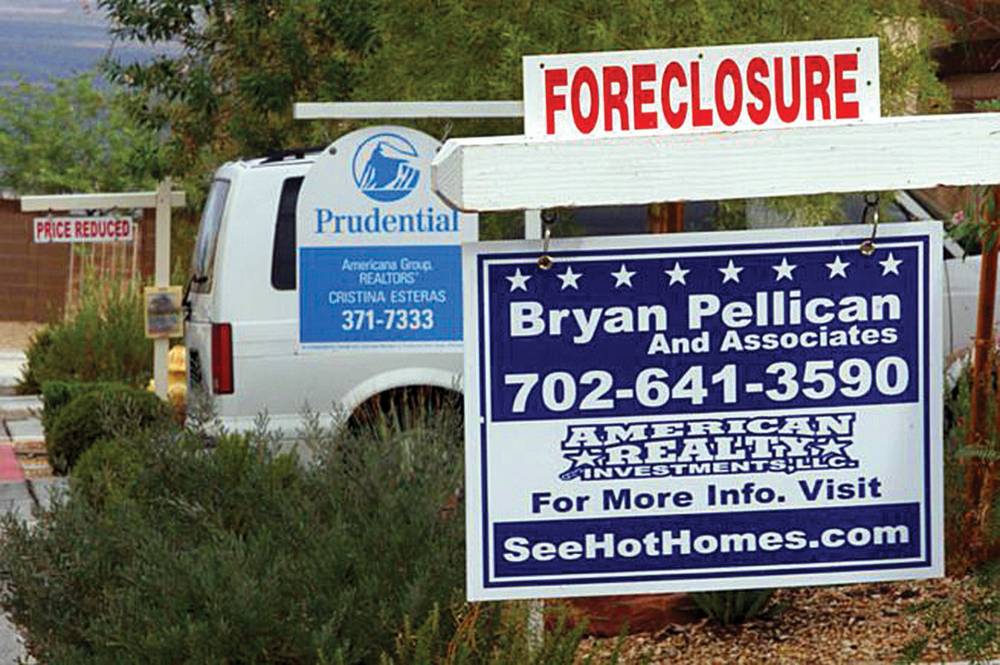



What started out as neighborhoods festooned with For Sale signs turned into vacant homes with Bank Owned placards. From there, the mood gave way to screaming billboards promising to Stop Foreclosure, and slowly, that turned into handwritten signs tacked on street posts offering Help With Loan Modifications. Glen Lerner & Co. changed their ads to focus on bankruptcy rather than car accidents. There’s a meeting at my library on “How to contact your lender,” because lenders’ phone lines have become labyrinthine death marches. One has to imagine that somewhere, probably in a parking lot off of Industrial, someone is selling sweet short-refinance deals from the trunk of an Impala.
Last year, more than 77,000 homes in Nevada were foreclosed upon, the highest in the nation. More than 14,000 homes in Clark County were in foreclosure in June, and 55,000 were already vacant.
And so where there is disaster, there are shiny new laws. Assembly Speaker Barbara Buckley, D-Las Vegas, authored one such law that went into effect July 1, and last month the Nevada Supreme Court heard testimony before adopting rules pertaining to it. The mission of Assembly Bill 149 is essentially to stop this nightmare by requiring lenders to come to the table for mediation—an attempt to modify loans before foreclosing on a homeowner. It asks everyone to be civil, to act “in good faith” to renegotiate if there is a way to satisfy both parties before the home tanks and the bank has a property to unload in a short sale.
Buckley’s assessment of the law a month after the bill was passed? “It’s easier to have an idea; it’s harder to implement it.”
Homeowners who receive foreclosure notices on their primary residences after July 1 may now request a mediation meeting with the lender, who, under the new law, must send a representative “in good faith” to negotiate. The meetings are set to begin in August, and Chief Justice Jim Hardesty has estimated some 1,500 mediation meetings will be requested each month and will be overseen by state-registered mediators (primarily attorneys and former judges).
The trouble is, the new law doesn’t actually require the lender to compromise—which leaves open the possibility that disingenuous lenders will simply send a rep to sit through the mediations with no intention of modifying the loan. In the hearings before the court last month, the heart of the issue came down to a discussion of “good faith”—how do we define that in this market?
Some lenders’ attorneys said that most of the loans have been sold to investors, so that the loan servicer really doesn’t have the authority to negotiate with the borrower, because the lender has a pre-existing contract with investors. So they’ll come and sit. In short, it’s a clusterf--k.
But, Buckley said, “The legislative intent was ... that the representative of the lender must have the authority to enter into the mediation. It cannot be a servicer who does not have the authority to enter into a modification. ... The remedy [if lenders don’t send someone with the authority to modify the loan] is that the lender is not permitted to proceed with the foreclosure ...” After a few months of that stalemate, she said, “investors [lenders] will send people with authority.”
Doesn’t the phrase “in good faith” lose its dignity just a tad if it has to be accomplished with a crowbar?
Indeed, at the other end of the disaster, we’ve got the cities of Las Vegas, Henderson and North Las Vegas asking for $367 million in federal dollars to buy empty bank-owned homes, restore them and resell them through the fed’s Neighborhood Stabilization Program. In this segment of the meltdown, nonprofit housing agencies working with the cities would buy bank-owned homes at 1 percent below the appraised market value.
Typically banks do end up unloading their foreclosed properties at or below appraised values—the first phase of the Neighborhood Stabilization Program allowed sales at as little as 15 percent below appraisal. So why wouldn’t the lenders prefer to sit down with a homeowner who can afford their own home at a price nearer to appraised market value than they’d get in foreclosure and short sale? That would seem like a good-faith conversation to have.
The rules of Buckley’s foreclosure law do require lenders to release appraisals showing the current value of the home and provide estimates of short-sale prices.
Let’s hope some of the mediations will lead to short refi. Right now, many agents speculate that only the interest on the loan will be up for modification in these meetings, which isn’t likely to stop the onslaught of foreclosures in a state where so many are underwater because the value of their home has dropped drastically, not just because of misused financial products.
However, it may lead to more opportunities for handwritten I Will Help U Stop Foreclosure signs.




Previous Discussion: