When we think about where we come from, we often imagine a straight line—homeland to here, origin to destination. But in reality, it’s less linear. Living Here, now at the Marjorie Barrick Museum of Art, shows that the truth is more layered.
The multimedia exhibit brings together 26 artists from East and Southeast Asian diasporas, all weaving personal experiences into a shared conversation about movement, belonging and cultural inheritance.
There’s no single way to talk about diaspora, and Living Here doesn’t try to force one narrative. Instead, the show lingers in the specifics and allows the media to speak.
 Endless, Quindo Miller
Quindo Miller’s interactive installation greets you before you see it. “Endless” seeps in like a familiar neighbor. In an awkwardly comforting karaoke backdrop, Cher’s “Believe” collides with America’s “A Horse With No Name” in a playful nod to the popular Asian family pastime.
“I took the idea of disrupting the museum,” says Miller. “I wanted to maintain the interactiveness and make karaoke a part of the main feature [where] you become the star or something when you’re singing and absorbed in your own world, but [also] sharing it with the public.”
Behind the flashing words, there’s an on-screen visual component made up of reels of an older version of Vegas that were taken by Miller’s family from the ’90s through the 2000s. That grainy nostalgia is deliberate. It collapses time. Miller’s memories, your memories and our scattered timelines all swirl in the glow of late-night living room performance.
Behind the karaoke altar hang framed wood veneers salvaged from Miller’s grandmother’s house in Guam after Typhoon Mawar in 2023. Titled “Homeland,” the pieces were painted pink and Mod Podged by Miller’s mother with magazine clippings from the ’90s, then rearranged and framed by the artist.
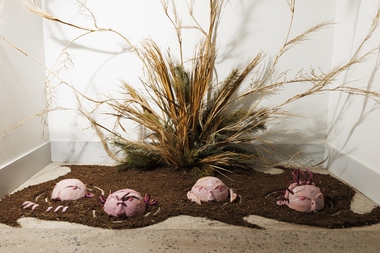
Eri King’s “Red 40 Zen MSG Rock Garden” offers a meditative piece with a fiery social critique. At first glance, it looks like a classic Japanese karesansui, or zen garden. But upon closer inspection, the gravel isn’t gravel—it’s pulverized Flamin’ Hot Cheetos raked into mesmerizing concentric circles while the rocks, sculpted from MSG, protrude upward.
 Bowl, Ian Racoma
“I was thinking about ... what is consumption,” King says. “The zen garden was a form of recognizing an Eastern practice and Eastern aesthetic that talks about healing or transcendence, whereas junk food for me was representing the body or capitalism.”
The piece, from King’s larger body of work Healthy People Are Bad for Capitalism, is both cheeky and sincere. The MSG rocks, she explains, are meant to “cleanse and purify the air from the chemical Red 40.” It’s a poetic contradiction, one that acknowledges toxicity in the culture while still finding beauty in the act of survival.
The pieces in Living Here refuse to flatten identity. These artworks don’t try to resolve the tension between past and present, East and West, belonging and displacement. Instead, they show how culture moves through time.
“The mediums are all unique and have their own identities, which is beautiful. As a collective whole, I feel like... an artwork can definitely stand on its [own]. But when you juxtapose them next to each other, they start to speak to each other,” King says.
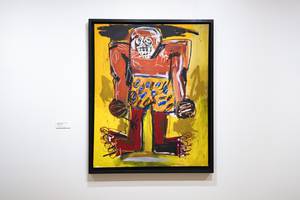
Included in the collection are oil paintings by Ian Racoma, a ceramic piece by Stephanie H. Shih and an acrylic painting on textile by Jeanne F. Jalandoni.
There’s a rhythm that emerges, colors echoing across the gallery, themes folding into one another. Nothing feels isolated. Everything is an active conversation.
LIVING HERE Thru December 20, Tuesday-Saturday 10 a.m.-5 p.m., free. Opening reception September 5, 5 p.m. Marjorie Barrick Museum of Art, unlv.edu.
Click HERE to subscribe for free to the Weekly Fix, the digital edition of Las Vegas Weekly! Stay up to date with the latest on Las Vegas concerts, shows, restaurants, bars and more, sent directly to your inbox!