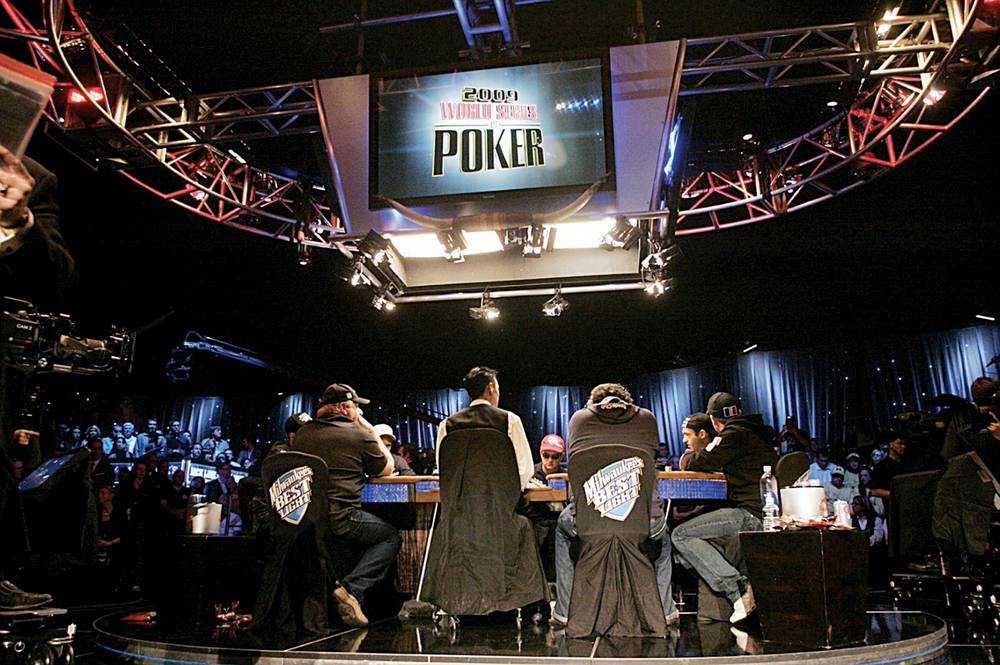
If there were ever a year when the World Series of Poker should have enjoyed a renewed boost, it was 2009. The stars had aligned in every conceivable way, and grandiose predictions seemed warranted.
“This is going to be the most-watched Final Table in history,” legend Phil Hellmuth predicted to me before it took place in two spurts on November 7 and 9.
And I believed him. It certainly made sense. Alas, he was wrong.

After all the noise in recent weeks about the conclusion of the 40th WSOP Main Event—the $10,000 Buy-In No-Limit Texas Hold ’Em tournament viewed as the pinnacle of the game’s prestige—virtually nobody bothered to report the outcome that actually mattered. TV ratings for the two-hour Final Table broadcast on ESPN on November 10 were actually down from the 2008 broadcast. The difference was nominal—this year’s show drew about 1.8 million viewers, and last year’s drew 1.9 million—but still, down is not up. Worse yet, ESPN says the 2009 ratings for the 31-telecast, 15-week season had a 1.0 share, which was even with the 2008 season.
All of which invites this important question: Now can we say that poker has plateaued in the United States?
This notion is one that makes World Series of Poker bosses groan. Skeptical journalists have long been taking note of poker’s relative weakness versus its white-hot years, 2003-2006, when poker TV shows were all the rage and Internet poker blossomed into one of the universe’s all-time most profitable enterprises. In 2006, when 8,773 players entered the World Series of Poker’s Main Event and the top prize hit $12 million, there seemed nothing that could slow the game’s stampede into the hearts and minds of American popular culture.
Poker overlords like to note that Congress put the kibosh on poker’s growth by passing a law in the fall of 2006 severely restricting the ability of most Americans to easily put money into their online poker accounts. This certainly is true and did result in a dramatic drop the following year in WSOP Main Event entrants. In fact, in the three years since, that figure has yet to top even 7,000.
That’s all well and good, but that does not explain the waning interest in watching poker on TV, and it is only via TV that tournament poker can become anything more than a peripheral part of mainstream American culture. Why would one’s inability to play online reduce one’s interest in following the pros? If poker wants to be compared to the big sports leagues, don’t they know that the vast majority of people who watch the NFL or NBA don’t actually play football or basketball? Most people watch sports to see other people do things they can’t do or can’t do that well.
The ratings stall is particularly stunning given the radical lengths to which the World Series of Poker and ESPN have gone to reverse a ratings decline that first became evident in 2006 and 2007. “Radical” is the only word that can describe the decision in 2008 to bifurcate this tournament, to play the bulk of it in July but pause play once the nine finalists emerge and wait until November to play out the rest.
This was a decision undertaken solely to increase TV viewership. The logic went that the four-month siesta would give the nine players a chance to promote themselves and the finale, thereby raising interest in the outcome, at least among people in their home cities or countries. It also theoretically would make it more intriguing to audiences watching the serial program on ESPN in the fall without knowing who emerged victorious.
Last year’s ratings did show an improvement over 2007, but not a dramatic one. WSOP brass explained that by noting that Americans and the world at large were consumed by the drama of the 2008 presidential election and the economic meltdown. The new format, too, would take some getting used to.
The trouble now is, 2009 should have been a banner year for this event and its TV show. Network TV viewership is up, reflecting that Americans want to be entertained and distracted from the ponderous, endless health-care debate. And, as WSOP Commissioner Jeffrey Pollack rightly noted, the Final Table contenders this go-around were directly out of central casting.
You seriously couldn’t get a more fascinating bunch unless you gave Joan Rivers a seat just for the hell of it. They included Card Player magazine publisher Jeff Schulman, who said he’d toss the bracelet in the trash if he won; ex-Bear Stearns exec Steve Begleiter, who some in the press decided was a face of the 2008 financial meltdown; and Darvin Moon, the 46-year-old logger from rural Maryland who’d never been on a jet plane before the summer tournament and had wackier down-home-isms than Dan Rather. There were also a Brit and a Frenchman to appeal to the international crowd, as well as the ultimate champ, a handsome college dropout from Detroit whose father just lost his auto-industry job and who, at 21, is now the youngest winner ever.
Most importantly, there was Phil Ivey, the first superstar to navigate to the Final Table in the modern poker era. The potential for a well-known pro with a gigantic following and elegant good looks to take it all seemed to portend that, at last, mainstream prominence was nigh for the game. True, Ivey refused to promote his own Final Table in the mainstream world, turning down pre-finale interviews with every major publication except the one to which he was obliged because of its association with the broadcast of the WSOP, ESPN the Magazine. Odds are good more people would’ve tuned in if they’d seen and liked Ivey on, say, Jay Leno or The View or read more about him. Now that his presence has proved irrelevant to the outcome and his moment has passed, he ought to realize that the ratings reflected as much about the limits of poker’s prominence as of his own fame.
But this piece is about the limits of poker’s prominence, and a ratings stagnation, given these favorable conditions, gives us a sense of where those limits are. ESPN boasted that viewership among men 25-54 rose 13 percent, which is fine but doesn’t exactly indicate audience diversification. In fact, that rise implies that some other demographic tuned out, given that ratings were flat.
This all should be fine. The WSOP is not in any kind of trouble. The 57 events that make up the overall tournament enjoyed an increased number of total entrants, and the total amount awarded in prizes was the most ever. The tournament has an offshoot in Europe and will have others. There’s robust growth among those who want to play, particularly overseas. It’s a multibillion-dollar brand.
Here in the U.S., though, the WSOP folks would be wise to stop predicting or striving for a resumption of the unnatural poker boom of the earlier part of this decade. That was a great run of luck, but it’s over now.

Previous Discussion: